
Weporta Joins World Trade Center to Bring Export Intelligence to the Next Generation of Exporters
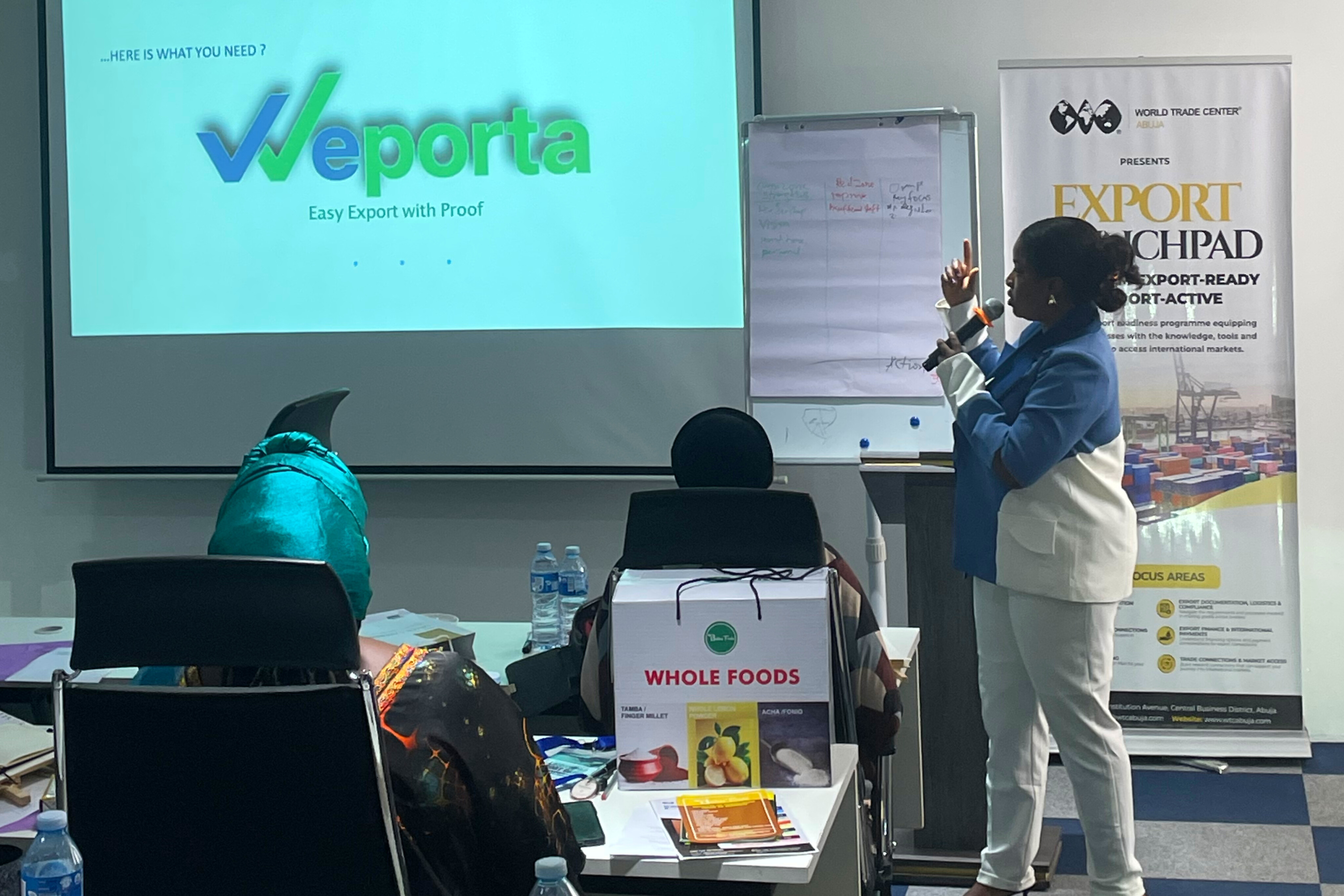
At the World Trade Center Export Launchpad Boot Camp, Nigerian businesses moved beyond the idea of exporting to the practical realities of building, executing and sustaining an export business.
For Nigerian businesses seeking to compete in regional and global markets, the journey requires a combination of market intelligence, export readiness, regulatory compliance, production capacity, logistics, financing, risk management and perhaps increasingly credible evidence that a business can deliver what it promises.
These realities took centre stage at the Export Launchpad Boot Camp, hosted by the World Trade Center (WTC) Abuja as part of the WTCA Deep Dive Global Series.
Held on 3rd September 2026 at the WTC Abuja Business Hub, the intensive programme brought together Nigerian businesses, trade institutions, financial-sector representatives, logistics professionals, export practitioners and other stakeholders for a full day of practical learning, workshops, expert conversations and networking. Weporta was also present, joining the trade world center to bring export knowledge to the next generation of exporters.
The programme was designed to move participants through a structured export journey; from strategy and market entry to operations, finance, execution and growth. Its emphasis was deliberately practical, combining expert presentations with hands-on workshops, peer collaboration, a finance and export-support panel and networking.
Starting with the Fundamentals
The day opened with a welcome address and programme overview from Ahmed Karim Adelaja, Vice President, WTC Abuja, setting the tone for a programme focused on equipping businesses with the tools and perspective required to approach international markets more strategically.
Alabi Goodness, Senior Trade Services Executive/Team Lead at WTC Abuja, subsequently led participants through Value Proposition Fundamentals and the Company Introductions activity, helping businesses begin by articulating what they offer and how they create value.
This foundation was followed by a practical Business Assessment Completion session facilitated by Dr. Suleiman Audu of Stardom Horizon Limited, giving participants an opportunity to examine their businesses more closely before moving into the question of where and how to export.
Understanding the Market Before Entering It
Market selection was addressed through “Selecting and Understanding Markets,” facilitated by Mr. Tunde Oloyede of the Small and Medium Enterprises Development Agency of Nigeria (SMEDAN).
The session explored market prioritisation and the use of tools such as the market prioritisation matrix and SWOT analysis by market; important considerations for businesses that need to move beyond simply asking “Where can I sell?” to determining “Which market makes strategic sense for my product and capacity?”
The conversation then moved into Market Entry Strategies, with Obatemehin Adekunle of the Nigerian Export Promotion Council (NEPC) examining approaches including direct and indirect entry, e-commerce, distributors and joint ventures.
Participants were subsequently challenged to assess their own readiness through “Is Your Business Export-Ready?”, facilitated by Mrs. Queen Ouserigha of the Organisation of Women in International Trade (OWIT).
Taiye Ibiyeye of NEPC then led participants through Mapping Export Readiness, followed by a feedback session where businesses were able to share challenges, experiences and ideas.
Together, these sessions reinforced a critical message: export success begins long before the shipment leaves the country.
From Production to the Point of Delivery
The afternoon sessions shifted from market strategy to the mechanics of actually fulfilling an international order.
Dr. Queen Okpa, of Women in Agri-Business and Export / Denca Global Courier Services, led participants through Production & Supply Chain Planning, focusing on capacity, inventory and supplier partnerships before taking them through a practical workshop on structuring export operations.
The logistics side of the journey was addressed by Dr. Aniefiok Aniekan of Iton Brightflow Logistics, who facilitated the session on Logistics, Documentation & Distribution, covering areas including freight forwarders, customs brokers and Incoterms.
For businesses seeking to enter international markets, these operational details are not secondary considerations. They can determine whether an export opportunity becomes a successful transaction or an expensive lesson.
Finance, Payments and Managing Export Risk
Export growth also requires businesses to understand how they will receive payment, manage foreign exchange exposure and protect themselves against commercial risk.
Mr. Olusesan Akanbi-Bello of Zenith Bank led the session on Payment Methods & Risk Mitigation, covering payment structures, foreign exchange risks and the challenges associated with non-payment.
He later joined Ms. Moboni Alemika of NEPC and Mr. Tunde Oloyede of SMEDAN for the Export Support & Financing Panel, moderated by Alabi Goodness of WTC Abuja.
The panel brought together perspectives from financial services, export promotion and SME development, highlighting the range of institutional and financial mechanisms available to businesses navigating the export journey.
Compliance Is an Ongoing Responsibility
Another important dimension of the programme was Process Management & Compliance Obligations, facilitated by Ms. Moboni Alemika of NEPC.
The session addressed resolution flows and ongoing obligations; an important reminder that compliance is not a one-time box to tick before exporting.
For businesses entering international markets, maintaining the necessary standards, documentation and regulatory requirements is part of protecting the long-term viability of the business and its relationships with buyers.
From Export Plan to Export Action
The programme culminated in Export Plan Development, facilitated by Gabriella Umeh, CEO of BoxNPick and Executive Director of Weporta, followed by a practical workshop on Drafting an Export Action Plan.
The session focused on setting Export goals, timelines, KPIs and actionable steps; But beyond the mechanics of writing a plan, the discussion examined a question that is often overlooked:
What happens after the plan is written?
Finding the right market and identifying a potential buyer are only parts of the export journey. The next challenge is demonstrating that the exporter behind the product is credible, organised and capable of fulfilling its commitments.
That was the context in which Weporta was introduced to the Export Launchpad cohort.
Introducing Weporta: Helping Exporters Trade With Proof
Weporta is a trade intelligence platform built around a simple proposition: Export better with proof.
The platform is designed to help exporters build a stronger credibility profile by bringing relevant export information, document and certifications together in a structured digital profile.
Registered exporters can build a verified profile, document aspects of their supply chain and export history, showcase relevant compliance and business records, and create a credibility profile that can be shared with potential buyers and other trade stakeholders.
The objective is to address a fundamental information gap in international trade. A potential buyer needs to understand more than what a business sells. They need confidence in who the business is, what it exports, where its products come from and what evidence supports its claims.
Weporta seeks to make that information easier to organise, demonstrate and communicate; using the export conversation function on the platform.
Its introduction to the cohort therefore complemented the Boot Camp’s broader focus on moving businesses from export readiness toward actual execution.
A Collaborative Export Ecosystem
The strength of the World Trade Center Export Launchpad Boot Camp was not only in the individual sessions, but in the breadth of expertise brought into the room.
From WTC Abuja’s trade services team, to SMEDAN, NEPC, BOXNPICK, OWIT and Zenith Bank, alongside entrepreneurs, logistics professionals and export practitioners, the programme reflected the reality that building Nigeria’s export capacity requires collaboration across the ecosystem.
The programme itself was structured to provide participants with more than training. Participants were expected to leave with a clear export strategy, market-entry knowledge, regulatory and compliance guidance, access to export finance and trade-support mechanisms, and a structured one-page Export Action Plan serving as a 90-day execution roadmap.
The programme also incorporated an aftercare component, including legal advisory for international trade contracts and IP protection, certification referrals for relevant export licences, and access to an export support desk.
This ecosystem approach is significant because no single organisation can address every barrier an exporter faces.
Businesses need access to markets, finance, regulatory institutions, logistics providers, professional networks and credible trade information.
The World Trade Center Export Launchpad brought many of these perspectives together in one programme.
Looking Ahead with Weporta: From Training to Trade
For Weporta, participating in the Export Launchpad represents an opportunity to contribute to a growing conversation about what Nigerian businesses need after they become export-ready.
The introduction of Weporta to the cohort creates a natural point of alignment with the work of the World Trade Center Abuja: helping businesses become better equipped to navigate international markets while strengthening the connections and infrastructure around them.
Weporta looks forward to continued collaboration with World Trade Center Abuja and to exploring further opportunities to support businesses coming through future cohorts and the wider export ecosystem.
The Export Launchpad may conclude at the end of the programme day, but for the participating businesses, the real work begins afterwards.
The next step is execution, and execution requires more than ambition.
It requires a plan, evidence, credibility, trusted relationships and the right ecosystem.
Weporta is building to be part of that infrastructure; helping exporters trade with proof.
Are you ready to build your export profile?
If you are an exporter looking to strengthen your credibility, become more visible to potential buyers and build a verifiable record around your business, join the Weporta database, get verified and start building your export profile with proof.
Click HERE to get started.